Blog
What Affects Garage Door Repair Costs in Melbourne
What drives garage door repair costs in Melbourne: springs, cables, openers, rollers and door type, plus how to get an accurate quote before any work starts.
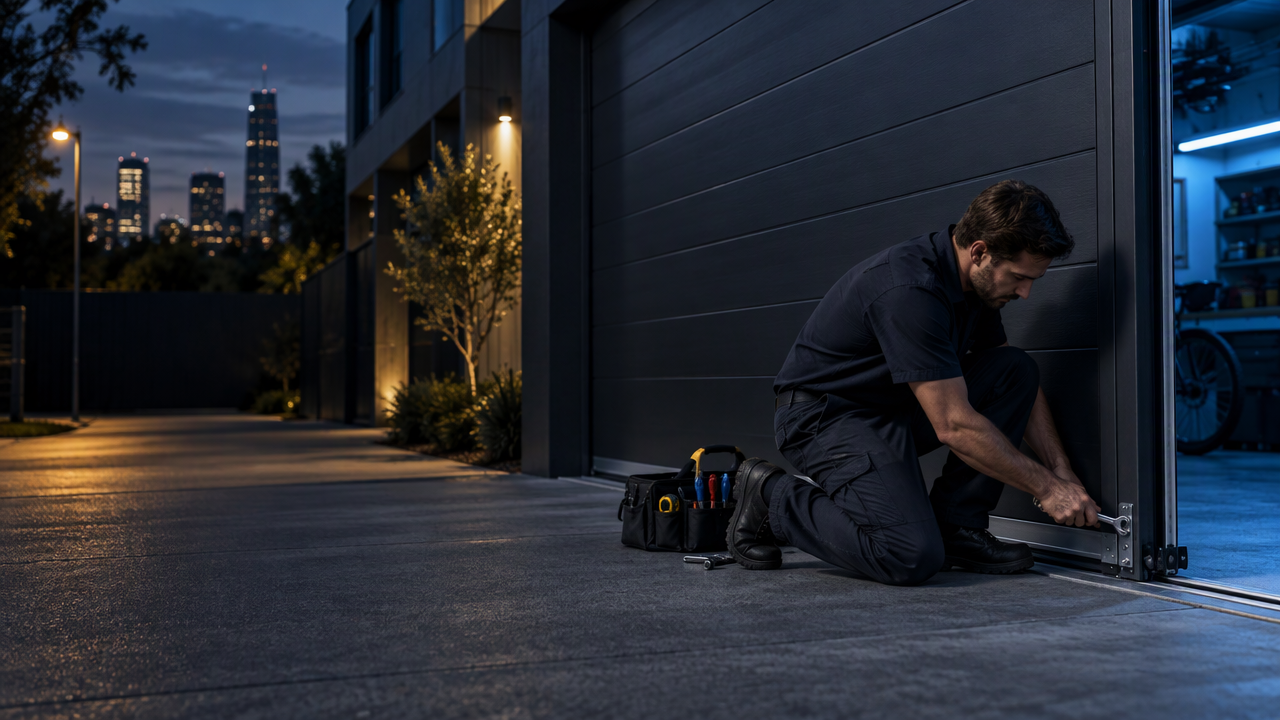
"How much will it cost to fix my garage door?" is one of the first questions people ask, and it is a fair one. The honest answer is that it depends on what has actually failed. A roller door that only needs its spring tension adjusted is a very different job from a sectional door that has come off its tracks and snapped a cable. This guide explains what drives the cost of a garage door repair in Melbourne, so you know what to expect and what questions to ask before agreeing to any work.
We do not publish a price list, because a number on a website cannot account for your door. What we can do is explain the factors that make one job quick and another more involved.
The type of door you have
Melbourne garages use three main kinds of door, and each has a different set of parts.
Roller doors are the simplest. A corrugated steel curtain rolls onto a drum above the opening, guided by two side tracks, with springs inside the drum doing the lifting. Fewer parts usually means a more straightforward repair. Common jobs are re-tensioning the springs, realigning a guide that has been knocked, and replacing worn guide strips. You can read more on our roller door repair page.
Sectional doors, also called panel-lift doors, are made of hinged panels that travel up curved tracks into the ceiling. They have rollers, hinges, cables, drums and a torsion spring, so there are more places for wear to show up. They are quieter and can be insulated, but a fault often involves more than one component. See sectional garage door repair for detail.
Tilt doors swing out and up as one panel on pivot arms and springs. They are common on older lock-up garages behind blocks of flats. When parts for an older tilt door are hard to source, the repair can take longer.
The size and weight of the door matter too. A double-width insulated sectional door is much heavier than a single uninsulated roller door, and heavier doors need larger springs and stronger openers.
Which part has failed
The single biggest factor is which component is at fault. Here is how the common repairs compare in terms of the work involved, from simplest to most involved.
- Adjustment and lubrication. Openers drift out of their limit settings, safety beams get knocked out of line, and rollers go dry. These are often short jobs.
- Wear parts. Rollers, hinges, guide strips and bottom seals wear out on any door used daily. Replacing them is routine.
- Springs and cables. Springs carry the weight of the door and are under serious tension. Replacing them safely takes the right tools and time, and the new springs must be matched to the door's weight. Our garage door spring repair page explains why this is never a DIY job.
- Opener faults. A stripped drive gear, a failed circuit board or a broken belt may be repairable, or the opener may need replacing. See garage door opener repair.
- Off-track or damaged doors. A door that has jumped its tracks, or has been hit by a car, usually needs securing, tension released, parts replaced and the tracks realigned. This is typically the most involved repair.
Faults also tend to travel together. A weak spring makes the opener work harder, which can wear out its gears. A worn roller can let a door twist, which strains a cable. A good technician looks at the whole system, so you are not paying for the same visit twice.
Parts availability and the age of the door
Newer doors from common manufacturers usually have parts readily available. Older doors, discontinued models and some imported doors may need parts ordered in, which can mean a second visit. Where a replacement part simply is not made any more, the repair may need an equivalent part adapted to suit, or it may be time to discuss replacing the door.
If your door is more than a couple of decades old and has needed several repairs recently, that is worth factoring into the decision. We explain that trade-off in more depth in our article on repairing versus replacing a garage door.
Access and the setting
Where the garage is and who owns the door also shape the job:
- Rear-lane garages behind terraces in South Melbourne, Fitzroy and Carlton can have tight access, and guides fixed into old brickwork sometimes need refixing with masonry anchors.
- Bayside garages in St Kilda and nearby suburbs often show corrosion from salt air on springs, cables and fixings, which can mean replacing more parts than on a sheltered door.
- Apartment car park shutters in Southbank and Docklands are common property. Repairs are arranged through the owners corporation or building manager, not the individual resident.
- Heritage areas such as East Melbourne may have rules about changing the look of a street-facing door, which affects replacement choices but rarely repairs.
How to get an accurate quote
You can save time and get a much more useful answer by giving a few details when you get in touch:
- The type of door: roller, sectional or tilt.
- Whether it is manual or automatic, and the opener brand if you know it.
- What is happening: is it heavy, noisy, crooked, stuck, or does the motor run without moving the door?
- When it started, and whether anything happened just before, such as a bang or a bump from a car.
- A short phone video of the door moving, if it still moves safely, and a photo of the motor label.
With that information, a technician can usually narrow the fault down before arriving. The final quote still comes after the door has been inspected by hand, because some faults only show up once the opener is disengaged and the balance is checked.
Questions worth asking before work starts
A reputable garage door technician should be comfortable answering these:
- What exactly has failed, and why?
- Is there a repair option, and is there a replacement option? What are the differences?
- Are you replacing both springs or one, and why?
- Will the opener be re-set and the safety reverse tested afterwards?
- Is any other part close to failing that I should know about?
If the answer to the first question is vague, or the only option offered is a new door or a new opener, it is reasonable to ask for more detail.
Signs you should stop using the door now
Some faults get much worse, or become unsafe, if the door keeps being used. Stop using it and call if:
- You heard a loud bang from the garage and the door is now very heavy.
- The door is hanging crooked or a cable is loose.
- A sectional door has come out of its tracks.
- The motor is humming but the door is not moving.
Running the opener in these situations can turn a spring repair into a spring, cable and opener repair.
Getting help in Melbourne
Kim Locksmith Melbourne Service repairs garage doors across inner Melbourne from our base at 119 Kavanagh St, Southbank. We are open 7 days, 7:00am to 9:00pm. Because we are also locksmiths, the lock on your internal garage door or rear gate can be dealt with on the same visit.
Call 03 4059 7723 or request a quote with a description of your door, and we will explain the realistic options before any work is agreed. You can also browse all our garage door repair services.